Saturday, August 30, 2008

Adaptable software interfaces for all

This post is proud to have been syndicated to the Ponoko blog.


A bendy straw


A common customisable interface. But we all know what it is and how to use it. Right?


The Guardian newspaper's always-interesting Technology supplement carried an article this week on research into adaptable interfaces.


Washington University academic Krzysztof Gajos has developed:


"a set of software algorithms that automatically generates a user interface based on four basic user-defined parameters. First, it selects the optimal functional elements like buttons, pull-downs, lists etc. Second, it decides how to lay out those functional elements in a window.


Third, it decides how to divide the space into a single window or as separate tabs. And fourth, it selects the size of a button to be used. The genius of the Supple system is its ability to predict how often a user will use a certain element, how much time is saved by using certain elements and the overall impact to performance."


It sounds like a progression of such dubious developments as Windows' 'personalized menus' (those that learn which options you use the most and display those items first), and predictive text. I have previously noted the trend towards customisable interfaces and the prospect of an interface that optimises itself for you personally is certainly alluring. But it always comes at a cost to standardisation - if we all have interfaces specific to us, how can we transfer to using someone else's computer, or even teach or communicate about a program without any common ground?


This is a problem that is as prevalant in open sourced hardware as well as software - there is a critical mass of deevelopers below which, you're going to be on your own as the only user of that system, and as such don't have any support or collaboration. If we all have slightly different versions of, say, a lamp cut by Ponoko, its great for us individually as we all have our perfect lamp, but it makes it very difficult, or labour intensive, to a) incorporate each other's new developments, and b) use each other's lamps (say if we have different modes of operation, assembly or light distribution). Not a world-ending issue I know, but it could become a problem.


The existing solution seems to be to always offer the option of reverting back to a standard design - you can turn of your predictive text, or expand a Windows menu to display all options again. And this is exactly what I do when I'm using someone else's computer or telephone. I am intrigued to learn how Gajos' solution will address standardisation of a software interface's visual language.

Friday, August 29, 2008

Machinate: Context Free to Ponoko possibilities

This post is proud to have been syndicated to the Ponoko blog.


My previous post about NYC Resistor led me to look into one intriguing item on their list:

Context Free is decribed as:


"a small language for design grammars called CFDG. These grammars are sets of non-deterministic rules to produce images. The images are surprisingly beautiful, often from very simple grammars."


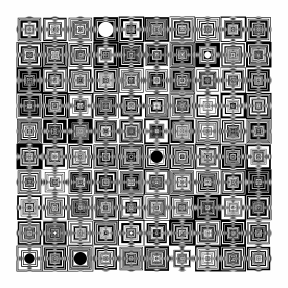
circle-square-3-grid by nimble


Above is the catchily named 'circle-square-3-grid.cfdg' by nymble, one of many images that can be viewed in the Context Free Gallery. Of course, because these images are generated using a certain amount of chaos, or at least unpredictability, these images are only examples of what you might get after you have downloaded Context Free and run the source file.


NYC Resistor suggest using Context Free to generate paths for laser cutting, a process I was keen to evaluate - it turns out it can be done remarkably easy, the success I guess depending on the type of image one is working with (ie. whether it translates into usable vectors for cutting or engraving). I successfully exported a .svg from Context Free to Illustrator, and with a little editing of colours had a set of paths that made for a usable Ponoko .eps file. In my case I used this Pringles-like character programmed by 'whistle tips':


Natty Boh CFDG by whistle tips

And here is the resulting .eps. - let's see some context free laser engraving everyone!

Incidentally there is some really amusing commenting on the CFDG website that goes with the above image!

Wednesday, August 27, 2008

Tinysaur!

This post is proud to have been syndicated to the Ponoko blog.


Hacker collective NYC Resistor have posted some great images of their Tinysaurs - scaled down versions of the classic tyrannosaurus skeleton model that their friend Martin sent them:


NYC Resistor's Tinysaur


I do love a good miniature. Apparently the very active group have just recently taken delivery of their laser cutter but have already put it to good use, duplicating Tinysaurs, making geometric art and doing the obligatory etching of iPhones.


NYC Resistor's Tinysaurs


NYC Resistor's Geometric Art


On their list of Things to 'LAZZ' are some itriguing ideas:


  • Cut and etch a picture of James Bond, and then slice it in half

  • Small floral silhouettes that can be used as pendants or earrings

  • Cut some geometric art created with Context Free

  • Some cardboard prototypes for a loom

  • Some general geometric interlocking stuff

  • An acrylic coat of arms

  • A “finger” mechanism for crawling robot

  • Some thin penrose tiles for penrose scarf

  • NYCR laser coasters (for Friends of Resistor)

  • And of course the obligatory etching of logos, warnings, and expressions into various Apple products


Martin perfectly somes up the excitement of digital fabrication and the web on his blog with:


"Now we can e-mail THINGS from Berlin to New York and vice versa!"

Tuesday, August 26, 2008

Robert Q. Riley - DIY vehicles

This post is proud to have been syndicated to the Ponoko blog.


Robert Q. Riley Enterprises, a product design and development consultancy from Arizona, offer a range of their (mostly) vehicle designs as downloads, some free of charge.


Robert Q. Riley's XR3 hybrid car


image © Robert Q. Riley Enterprises


The latest is the XR3, a three-wheel sports car that can be "outfitted with different power trains to create a 125-mpg, diesel-only vehicle; a 100-mile-range, battery-only vehicle; or a hybrid for increased performance and fuel versatility." For just $170 you get "eighteen D-size (24 x 36 inch) drawing sheets, one 32 x 64 inch full-size template sheet, and a 149-page construction/technical manual with over 200 photos and illustrations." Not bad.


I've been having trouble getting the free designs to download, but what does work is a whole host of how-to information and technical papers that are also available for free. Evrything from One-Off Construction Using Fiberglass Over Urethane Foam to Three Wheel Cars: The Factors That Determine Handling and Rollover Characteristics.

An impressive site, a little hard to navigate but only for the abundance of material held within..


via JEC group via Core77

Sunday, August 24, 2008

Are we Anti-design?

This post is proud to have been syndicated to the Ponoko blog.


Thoreau Cabin


Anti-design, or Pro-design? Thoreau's cabin at Walden Pond- Stephen Erat at TalkingTree [via Treehugger]


Martyn Perks writes at sp!ked about the phenomenon of 'anti-design', that is,


"Designers who focus on producing only meek and sustainable things ... denying their own creativity and impact on the world."


But then sp!ked describe their position as one of:


"waging a culture war of words against misanthropy, priggishness, prejudice, luddism, illiberalism and irrationalism in all their ancient and modern forms."


so perhaps their controversial stance is not surprising. It is one however that I must disagree with as it makes the sweeping assumption from the outset that to constrain ourselves when designing is somehow at odds with exercising our creativity: a gross error. Perks does not waver from this from this assumption, citing Philippe Starck's new green direction as a prime example:


"Starck’s wind turbine ... creates the illusion that the energy problem is one of consumption, not of production. We need bigger, better and dependable power stations (including nuclear ones), not small home generators."


Perks seems to be conveniently ignoring the fact that the world's problems are also our personal problems, and we all have a responsibility to take action to rectify them - I seriously doubt that Starck expects his home generators to solve the energy crisis, especially as his aim seems to be to raise awareness more than anything else. What's more, Perks sees green design as somehow less able to "make an impact", this being taken as the main aim of any design. I think most designers are more interested in solving problems, and if this means making an impact on society in a big way, so be it: sustainable design is no barrier to this. Surely the idea is to make an impact on the problem, anyway?


Perks' ultimate sentence really does take the biscuit however:


"Let the government, politicians and policymakers take the flak for the consequences of design, while leaving the designer with the job of recreating the world around us. The designer, while living in the real world, cannot be constrained by it, because it’s his or her job to make it better."


An astonishingly short sighted statement in my opinion but then I'll happily admit to being something of a misanthrope! Do read the whole article and make up your own mind.

Friday, August 22, 2008

Scrappy furniture getting smarter

This post is proud to have been syndicated to the Ponoko blog.


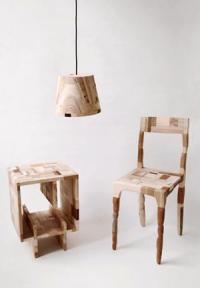
Amy Hunting's Patchwork Furniture looks like a charming response to the re-use of wood offcuts. The offcuts were first assembled into boards, made up of a patchwork of pieces, before being formed into furniture - a possibly laborious process, but one that I imagine offers much more versatility than simply reinterpretting scrap pieces in their existing form. Of course, this is basically how chipboard and MDF are made - by glueing together wood particles - but the results are much more attractive to the eye. Would be good to see a board material like this as a stock at materials suppliers.


Patchwork Furniture


via Core77


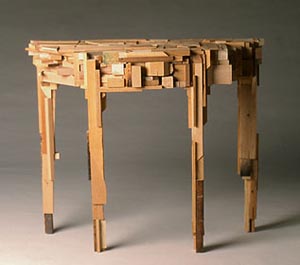
other recent pieces in the same vein are Gord Peteran's Table Made of Wood:


Table Made of Wood


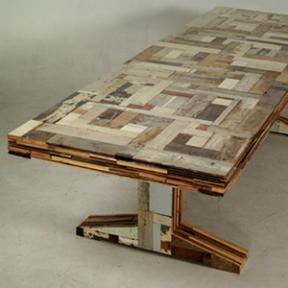
and Piet Hein Eek's Scrapwood range:


Piet Hein Eek's Scrapwood range


[both via Treehugger]


which are fairly typical responses to the idea of reusing scraps: by reassembling them directly, which is probably the most costly solution. As Treehugger puts it:


"...while well crafted scrap wood furniture definitely becomes precious in the hands of Piet Hein Eek, it does not come cheaply and these pieces make particularly hefty investments."


Amy Hunting seems to be addressing the idea at a more commercially sustainable level which is the bigger challenge really: Fusing re-use, unique functions, aeesthetics and economy of scale.

Incidentally, Nottingham, UK based online scrap dealer Unique Scrap Store looks like a great place to start for finding lots of the same reclaimed item!

Thursday, August 21, 2008

Yet more papercraft

This post is proud to have been syndicated to the Ponoko blog.


It's been a while since I've mentioned any downloadable/printable papercraft, so this is to get some links off my chest:


Konica Minolta Crab models


Konica Minolta's Papercraft Crabs are rather impressive, as are this range of models from Kirin (including a polar bear and a neat globe).

via Make


Korg MS20 model


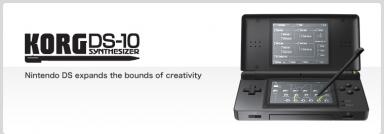
If the Korg DS-10 doesn't excite you then maybe this will: the Papercraft Korg MS20.


via Make


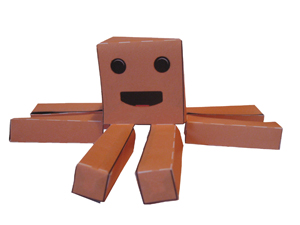
Octoboy


Lastly, Glasgow maker Kritchard's first foray into kits, Octoboy:


"He possesses the usual octopus super powers of fitting into tiny spaces, disguise and lateral thinking, but is still a little nervous about embarking on a life of crime prevention."


Captain Blueboid by KritchardIncidentally, you could do a lot worse than spend some hours perusing Kritchard's site, which exhibits his vast repertoire of custom-crafted cardboard robots, safari animals, ingenious cracker tat robots and his most recent creation, a charming wee pirate clock.
Tuesday, August 19, 2008

Alice Rawsthorn on Craft

This post is proud to have been syndicated to the Ponoko blog.


Alice Rawsthorn wrote an interesting article recently pondering on the modern relationships between designers and craft, a distinction that is becoming increasingly blurred in my opinion.


"Many 20th-century modernists disdained craftsmanship in favor of deploying industrial technology to design for the masses, even though much of Marcel Breuer and Le Corbusier's early "machine age" furniture was actually made by hand. The opposing camp was equally hostile. When the industrial designer Jasper Morrison developed a collection of ceramics in 2000 to be made by the artisanal potters of Vallauris in France, it was slammed by a French crafts magazine as "looking as if it came from a factory."


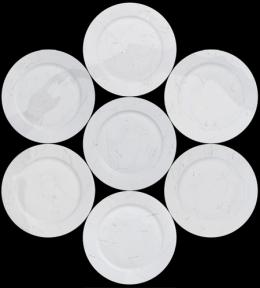
These days we're after a combination of both: we want hi-tech, standardised products, yet we want each to be unique to us, to be customised. In her article, Rawsthorn focusses on the collaboration between the Swedish-German design team of Reed Kram and Clemens Weisshaar and Nymphenburg porcelain to produce Mt Private Sky: a line of highly finished plates that depict the night sky on the day of the user's birth (incidentally, according to Geekologie, the plates are hand-painted in gold and platinum!).


My Private Sky


Apparently the project was conceived as a means of rejuvenating the product, and adding value, or rather adding a feature to better justify the high cost of handmade crockery in comparison to mass-manufacturer competitors. Interestingly, Weisshaar and Kram are digital devotees, working remotely from each other over the internet and in this case, developing a software program to generate the nightsky data for the user - essentially a mass-customisation platform. So despite having radically different artforms, designers can become part of a craft-based operation, achieving never-the-same-twice results through computational methods. Rawsthorn observes that:


"Perhaps surprisingly, computer programming conforms to the classic Arts and Crafts Movement definition of a work being made by one pair of hands."


Ironically, this definition wouldn't strictly fit with the My Private Sky project, each plate being the result of a few different pairs of hands, including those of the programmers. It would however fit many makers and Ponoko users, our modern day craftspeople honing their very modern but none-the-less meticulous skills through making objects. This is the significance of the Arts and Crafts movement today: just as there was a backlash against industrialism, today there is a backlash against cold mass-manufacture: again we long for a return to local, personal values, but this time its not at the cost of technological benefits. The modern craftsman is a master of contemporary technology too, and this might not be so hard as the web and design tools make fabrication easier and more democratic.

Thursday, August 14, 2008

Prototyping in a flash with littleBits

This post is proud to have been syndicated to the Ponoko blog.


little Bits coffeemaker video screenshotIf this video isn't totally inspirational, I don't know what is. An idea for a coffeemaker is drawn, and immediately prototyped in foam/cardboard and an electronic components kit to make an interactive prototype. I know its timelapse, but if only all prototyping could happen so quickly and intuitively as the video suggests!


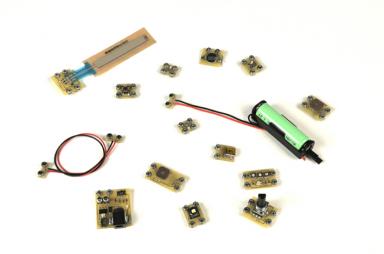
This is of course made possible by littlebits, a rapid electronic prototyping platform developed by Ayah Bdeir and Jeff Hoefs, supported by Smart Design and Eyebeam Openlab (those responsible for LED throwies and general graffiti research). From the littleBits site:


"littleBits is an opensource library of discrete electronic components pre-assembled in tiny circuit boards. Just as Legos allow you to create complex structures with very little engineering knowledge, littleBits are simple, intuitive, space-sensitive blocks that make prototyping with sophisticated electronics a matter of snapping small magnets together."


littleBit early prototype


Image from Make


As Make pointed out of the early prototypes, the beauty of littleBits is that the connectors are magnetic, meaning that a) they plug together almost of their own accord, and b) they automatically connect in the correct polarity, electrical and magnetic. Slick.


littleBits is still in development but there are three videos up demonstrating the early prototype, including this one in which 4 industrial designers prototype four objects in about 25 minutes. Can't wait. Did I mention the whole thing will be open source?

via Make

Tuesday, August 12, 2008

DIY Pearl Traps Table


Traps Table 210708
Originally uploaded by Zero-waste Design
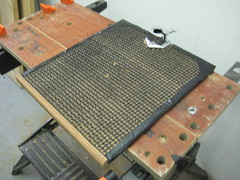
I recently built a quick addition to my drumkit: A traps table/tray, for holding the glockenspiel, sampler or just sticks/mallets/hand percussion as requirements dictate.

I'm quite pleased with the simplicity of the design and its integration with regular Pearl hardware: I used a standard tom mount from a tom that I no longer use, so that this tray fits neatly onto a tom arm adjusted to point upwards. I've always appreciated the modularity of Pearl hardware, which comes into its own when you can use a tom arm with the bottom half of a cymbal stand, making hacks like this traps table feasible.

The table is plywood covered in non-slip mat, has a ledge at the bottom and is trimmed with duct tape. The tom mount can be placed as shown so that the tom arm passes right through, allowing the table to be positioned as low down as possible. Alternatively, the tom mount can be positioned centrally on the underside in which case the arm does not pass through. The whole assembly can be flipped over and used in reverse too - I've found that the more versatile your hardware the better, as you will always get gig situations where you want your stands to do something unusual that they probably weren't designed for!

Notes and photos on the construction are given here.

Configurators in abundance

This post is proud to have been syndicated to the Ponoko blog.


Frank Piller's Mass Customization website reports on:


"mass customization, personalization, customer integration, and open innovation -- strategies to co-create value between companies and customers."


Frank Piller is a RWTH Aachen and MIT academic, and hence the site is wordy, but is an interesting delve for anyone thinking about open innovation and mass customization, with many links to current research, of which there seems to be much in Germany. Slightly easier to dip into is Piller's blog on the same topics.


One interesting feature of the research driven set, is the International Configurator Database , which, despite sounding like a defence agency project, is in fact a through database of seemingly every website that enables one to customise or configure (hence configurator) a product before buying it.


My favourite from this has to be Sonor drums' SQ2 system, which allows you to specify everything down to the very plys that make up your drumshells. Billed by the Configurator Database as the most exotic of all configurators!


Sonor SQ2 configurator


via Open Source Product Design News

'Ohm' cardboard sampler by Ofir Yaloz

This post is proud to have been syndicated to the Ponoko blog.


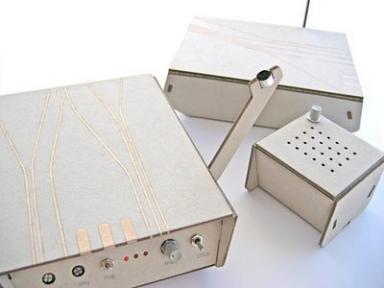
Designer Ofir Yaloz of Shenkar College of Design, Israel has produced an audio sampler constructed from laser cut cardboard with circuitry screenprinted onto the surface.


Ohm samplers


The designer's Noise Design website is a brief, to-the-point Blogger affair, with some great photos of the finished products, the manufacture of them, and the early prototypes, as well as videos demonstrating the unusual interface:


"...by touching the printed surface the user can modify the sound in different ways."


Ohm cardboard nets


Ohm prototype


It's very alluring work, combining an everyday material with unusual applications, firstly as a precision enclosure, and secondly as a substrate for circuitry - whilst still producing a very elegant, minimal device. I particularly love the microphone solution! The conductive coating method appears quite esoteric, employing a "paint made with pure silver and copper" and various stages of plotting onto PVC stickers, hand painting , peeling , and direct screen printing (see comments on the website).

Reminds me of Evil Mad Scientist Labs' paper circuitry:

EMSL Paper Circuitry

Image from EMSL

via Make

Saturday, August 09, 2008

Torrone & Fried: Citizen Engineers

This post is proud to have been syndicated to the Ponoko blog.


Limor (Ladyada) Fried of Adafruit Industries & Phillip (pt) Torrone of MAKE magazine are collaborating in producing a series of films entitled Citizen Engineer.


Limor Fried in Citizen Engineer


Billed as "an online video series about open source hardware, electronics, art and hacking", the first episode sees our hosts engage in a bit of SIM card and payphone hacking. At 30 minutes long, its a proper programme that I can imagine a TV channel might go for, its appropriately home-made filming aesthetic lending the programme a bit of charm. The charm of the hosts doesn't come across as well on video sadly, the delivery being a little rapid and dry. Fried says the aim is however "to capture the fun and not so fun parts of hardware hacking on video", so hopefully they can lighten up a bit in the next episode! It is also worth noting that the programme has a rather groovy opensource-enabled soundtrack.


Also up are the pair's slides from the debut presentation at "The Last HOPE" conference, in which it appears the revenue from video views and kit sales are compared (not sure about this - maybe someone who was there would be better qualified to say!), with the kits coming out top.


Torrone says:


"We think there are some good opportunities for people who makes things to share their skills and how they create and make a living doing that (and we've shared some initial numbers). Videos are becoming the new "text files" - if you grew up learning about some techy topics by text files shared around you likely recognize the analogy. Etsy sellers, makers and anyone who makes things might want to experiment with this model of sharing their skills with other online via video and having actually things to buy as part of the video, but not just an "advertisement" or "infomercial". "


Once again, pt and Ladyada at the forefront of the making business, and showing marketing as yet another string to their over-talented bows!

Big Blue Saw free day been and gone

This post is proud to have been syndicated to the Ponoko blog.


Big Blue Saw is a company new to me - based in Atlanta, Georgia, they offer:


"... laser cutting of plastic, waterjet cutting of plastic, waterjet cutting of aluminum, waterjet cutting of stainless steel, and waterjet cutting of plain steel, as well as other materials. We offer instant quotes and online ordering."


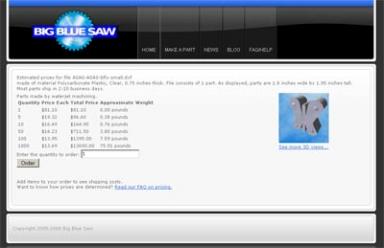
A bit like a more local Ponoko, with more processes but no sales & marketing platform for one's designs, the website does offer a cool interface for checking DXF, PNG or GIF files and getting quotes. I plugged in a file I've been working on and it quickly identified a few dozen errors! Disappointing for me, but thorough and upfront at least.


Big Blue Saw Screenshot


Screenshot from bigbluesaw.com


They also have their very own applet for designing a part within your browser. Once you've uploaded or drawn your design, you are asked for a material and thickness for it to be cut in and pretty soon the website spits out a rundown of part weight, 3D visualisation, and price comparison against production quantities.


The business seems to be aimed more at indie designers and small businesses looking for quick and simple cutting in batch runs, and I would consider using them were it not for the shipping and their 9" x 9" limit on part size. It would be great to have a business like this in Scotland, and in collaboration with Ponoko for bringing in local custom surely fabricators such as these could really take off?


Sadly I'm a day late for you to get a free part from Big Blue Saw, sorry about that!


via Make

Behind the scenes with Jim Watt: multi-faceted maker

This post is proud to have been syndicated to the Ponoko blog.


Last week I went to visit a maker local to Glasgow: Jim Watt, paper engineer, theremin fancier, 3D photographer and proprietor of clockworkrobot.com.


I discovered Jim's site when his Solar Powered Theremin project was posted to Make (which has subsequently been added it to Maker Shed). Always intrigued by simple musical instruments, I got in contact, discovered we share a city, and Jim very generously let me pop by to chew the fat of making and hacking.


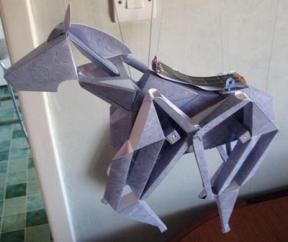
Jim Watt's Kinetic Horse


Jim Watt's Kinetic Horse - in solar powered version


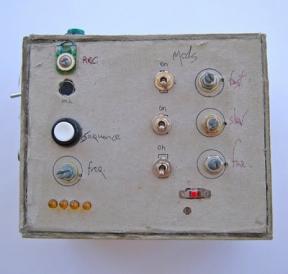
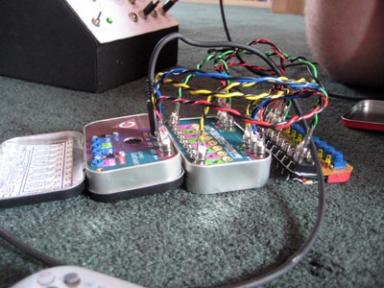
Jim has a background in jewellery making and metalwork, and a passion for sci-fi: a combination which led him first into building fantastic robotic sculptures, and on to kinetic engineered paper sculptures inspired by the revived Doctor Who series, which were then picked up and marketed by the Doctor Who people themselves. Meanwhile, a solar powered horse automaton led Jim on to create the solar powered theremin, which has now led to a modular system of synths and sequencers in Altoid tins. Quite a prolific chap, Jim admits to the affliction of being rather fickle, turning his attention to each project that he thinks up with focus and immediacy. Thus I caught him in the excitement of developing his Pocket Synths, though I felt that he could have been ensconced in any other of his many interests if the wind were blowing differently that day.


Jim sells kits through his website and has had a lot of interest in the solar theremins, but is beginning to lament the time and effort that he must put into building the kits - a bit of a mundane chore for such an active mind! A problem that many makers must face, he would like to employ someone to do the legwork of making up kits but is loath to entrust quality control of his very personal projects to another. He feels that he can't put as much time into development, publicity and marketing as he would like for all the production he has to do. I suggest that this is why I find collaboration and open sourcing so exciting: generally all developers are equally passionate about their subject, one can share out the necessary tasks more effectively - however this poses the problem of the 'non-commercial' clause: ultimately the creator has to make their money from production, and in an open model this can't be done without restricting commercialisation in some way. At the end of day, it seems one must be willing to give up some hold over one's creations if one is to share the burden the demand for a successful product.


As it is, Jim's departure into open hardware was a result of disillusionment with the system of patenting and copyrighting. He notes that one can spend much time and money protecting one's IP, yet this still will not protect you from another person plagiarisation unless one can afford to prosecute them: not a situation independent makers generally want to get in to. So Jim makes his schematics and source available for free, and charges for the kits, a model which is working well for him and many others. Amusingly, Jim sells more solar theremin kits with Altoids tins included than without - highlighting makers' desire for convenience (or maybe dislike of Altoids) over economy - but irritating as Altoids aren't really native to the UK, so are a bit weird to be exporting, and meaning Jim always has a steady supply of mints!


Jim Watt's Pocket Synth


A feature of Jim's Pocket Synth system that I enjoyed greatly was the tactility and elegance of the tins as a 'building brick' system - one can arrange one tin in the lid of another, thus making the act of building your synth/sequencer that much more satisfying. This kind of joyful coincidence is only achieved by 'hacking', modding, playing with ideas physically and resourcefully, and thus in danger of being lost in that haptic gap. Additionally, the whole system is executed through the joining of simple electronic elements using patch cables, making the logic of synthesisers much clearer to me than any diagram or standalone synth ever has.


It was great to observe the backstage workings of a modern day maker and kit distributor - many thanks to Jim for having me!

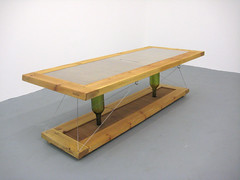
Tension Table 080808


Tension Table 080808
Originally uploaded by Zero-waste Design
The Tension Table is pretty much finished, finally. Plan is to put it in the Southside Studios Furniture: Manufacture show in November, once its got clear bottles on it. Very pleased.

Skips and Stuff - a Googlemap

Hello. In an attempt to make better use of the tons of stuff that is discarded on the streets of Glasgow and I'm sure other cities, I've started a Googlemap for marking the location of skips and 'rubbish' and sharing info about what stuff is available to the discerning skip diver. Do feel free to contribute. In fact there's only one up at the moment, but hopefully you get the idea.

In an ideal world the Councils would post info from flytipping complaints here in case anyone local can use the stuff, or would use this as a tool for efficiently collecting rubbish that has been sitting for more than a few days.

Obviously, freecycling/freesharing is always preferable to flytipping/skipdiving, this is not meant to discourage that, simply encourage better resourcefulness. Its a bit of an experiment. And its inspired by the excellent Glasgow Greenmap - maybe they could be incorporated. The Skips and Stuff Googlemap is by contrast global.

Wednesday, August 06, 2008

When gadgets do the unexpected

This post is proud to have been syndicated to the Ponoko blog.

I thought the Nintendo DS was just a games console, right? Wrong. It's one of many devices that are being reinterpreted due to the considerable potential of their interfaces. So now your DS is a Korg MS-10 synth, and your iPhone is in fact a piano. And lets not get started on the plethora of Wii hacks.


The Korg MS-10 on the Nintendo DS


I like how this trend is growing - it seems that our products are becoming increasingly unspecific: they perform as comfortably with one function as quite another, and don't look out of place in the process either. Presumably this is because each are essentially portable computers, and have completely customisable interfaces: the iPhone through its multi-touch screen, the DS through its dual screens, and the Wii simply through its gestural controllers-and-TV combo. And the manufacturers are happy to encourage this multifunctionality, as the industrial design is generally so minimal and anonymous, we can subconciously (and to some extent physically) project onto it the aesthetics of any device.


ThinkM on laser cutting for 3D products

This post is proud to have been syndicated to the Ponoko blog.


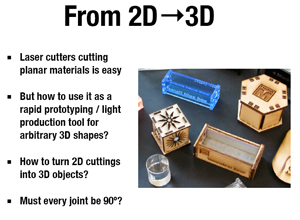
Tod E Kurt's of ThingM, the "ubiquitous computing device studio" has posted the slides for a talk he gave at the intrigueingly titled Sketching in Hardware ‘08 conference that was held at RISD in Providence, Rhode Island this year.


The slides and notes make an interesting perusal, covering the evloution of ThingM's BlinkM modular lighting product, the appropriateness of Wii peripherals as a platform for hacking, and most interestingly, using 2D laser cutting to make 3D enclosures, clearly a hot topic currently (hence David's and my recent posts).


ThinkM slide


Its great to see the areas of electronic/hardware hacking and laser cutting/engraving converging due to their applicability to open sourcing and personal fabrication - hopefully we will soon see some concerted collaboration between independent hardware and product makers to develop some really sophisticated open products.


via Make


Playing with Constructionism - Part 3: Making

This post is proud to have been syndicated to the Ponoko blog.


Its easy to see where our childhood toys and our adult gadgets cross over: kits. In both instances, users are buying into a kit, a product system within which they have the freedom to build according to instructions or to diverge into the realms of adaptation. Ladyada reported recently on two "heartwarming stories of mass kitting" in which her kits were used as tools for learning and teamwork - clearly her kits straddle the camps of 'kits for play' and 'kits for products'.


Thanks in no small part I'm sure to the likes of Maker Shed, the kit is the hallmark of the discerning business headed maker, and an area of great interest to anyone building a business around making.


So when our products inhabit a platform that is so easy that anyone can edit their own products, what does this mean for designers? A Core77 article asked this very question of its readers quite recently, and the response is interesting as a synopsis of the arguments.


From the blunt:


"... [design] is a 360 degree approach and how you integrate other disciplines into it. if you can't do that, then yeah, joe six pack is going to eat your lunch with the 5 axis cnc he built in his garage."


to the rather more considered:


"It's possible there may be a time where, when you buy your next iPod or Nokia or Dyson, you don't get a physical item, but a disc full of 3D files which you assemble into a unique product. Some of the parts will be mandatory and unchangeable, some will be optional, some might be modifiable if that's what you want to do. Then you take your "design" to an authorised store who manufactures it for you. Doesn't in any way mean that the role of the designer disappears, but it would change the consumer landscape significantly."


It appears that yet again, the answer depends on how the designer defines themselves. If you are a designer of objects exclusively, you may find your business slowing. However if you're a designer of product systems, (ie. if you're making the kits), then as Sir Clive Sinclair found out, your future could be secured for years to come.

Playing with Constructionism - Part 2: Child's play

This post is proud to have been syndicated to the Ponoko blog.


I suspect, perhaps pessimistically, that the reason that I do not program my PC like I programmed my Spectrum is not to do with the technology per se: rather it is due to the propensity for creative construction lying predominantly in a) the naivety, and b) the abundance of time peculiar to childhood.


Alle Meine Klange


Image from PKNTS.com


It is in the child's market that I am sure we can see the best innovation - for one thing it seems to inspire toy designers in a way that adult gadgets don't. For example PKNTS's Alle Meine Klange - a modular sound toy that Make reported on recently - looks like great fun: a simple, highly potent platform for playing with electronic sounds between computer and tangible blocks. Lego, Meccano, Quadro were all kits that I and countless others revelled in as children and I think are responsible for many people's DIY and 'hacking' tendencies, not to mention simple mechanical knowledge, a theory that is borne out by the prevalence of these kits in design studios generally!


The wikipedia article on constructionism as a learning theory postulates that:


"learning is an active process wherein learners are actively constructing mental models and theories of the world around them. Constructionism holds that learning can happen most effectively when people are actively making things in the real world."


Clearly the trick to designing products that people love to play with right through into adulthood, and can still apply, is in building a product platform, a system, that users can bend to their own needs, and that doesn't require huge amounts of skill or experience. Which is basically what is slowly happening now in industrial design thanks to CAD, the web, and digital fabrication.

Playing with Constructionism - Part 1: Sinclair

This post is proud to have been syndicated to the Ponoko blog.


Architectures of Control posted a while back on the subject of Sir Clive Sinclair, the British inventor behind the beloved ZX Spectrum, bemoaned C5 personal vehicle, and now the A-frame folding bike. Dan Lockton links to an interesting BBC interview in which Sir Sinclair talks about a prescient speech he gave back in 1984, the potential of online collaboration, and the highs and lows of being an inventor. It is interesting that Sir Sinclair defines himself clearly as 'inventor' after all he has been through in setting up Sinclair Research, a choice which I have discussed briefly before here. Planet Sinclair is a great resource on the man, more so than Sinclair Research's own site.


Sir Clive Sinclair


I've also talked about my love for the Spectrum before, and its relevance to open sourcing in terms of the medium of audio tapes (World of Spectrum is a great resource for all your old spectrum games). Of course the other side of the coin is the Spectrum's role in encouraging people to write their own programs and edit each other's - as Lockton puts it "a fantastic constructionist success for a generation in Britain."


from Wikipedia:


"Since it was cheap and simple to learn to use and program, the Spectrum was the starting point for many programmers and technophiles who remember it with nostalgia. The hardware limitations of the Spectrum imposed a special level of creativity on game designers, and for this reason, many Spectrum games are very creative and playable even by today's standards. Games for ZX Spectrum are developed and released even nowadays."


However it seems Sir Sinclair thinks that this tradition of tinkering is gone:


"When I was starting in business, and when I was a child, electronics was a huge hobby, and you could buy components on the street and make all sort of things, and people did. But that also has all passed; it’s almost forgotten."


I find it hard to agree. The hacking/making community is strong online, as is the open source software community clearly. But as Lockton suggests, The activity is nowhere near as accessible as Sinclair Research made programming with the Spectrum - I can't begin to imagine how to write myself a Windows program, yet as a child I would have got stuck right in!


[Part 1 of 3]

SketchUp, Inkscape, and Ponoko Laser Cutting

This post is proud to have been syndicated to the Ponoko blog.


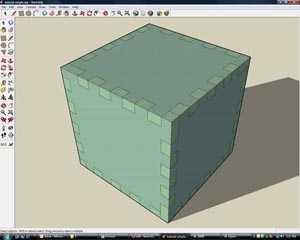
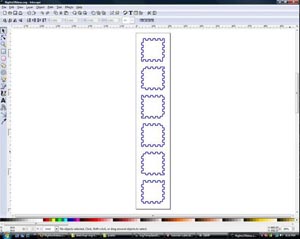
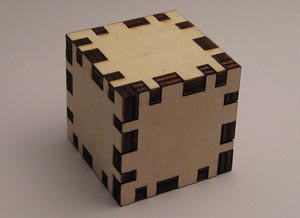
Flights of Ideas has posted two instructables investigating a method of translating data from Sketchup, into Inkscape and on through Ponoko into 3D object.The first instructable describes how one can use a plugin that he himself has authored for exporting faces in SVG format, that is, Scaled Scalable Vector Graphics format, which can then be imported into Inkscape:


"When I first started using Ponoko I found that there weren't any specific tools to enable me to export my SketchUp 3D designs. It is really hard to design in 2D and visualise a 3D result (unless you're an architect or do this for a living); that's why I wrote the SVG plugin."


Flightsofideas' cube in Sketchup


Flightsofideas' cube in Inkscape


Flightsofideas' cube in Ponoko


From Sketchup, to Inkscape, to Ponoko - images from Flightsofideas on Instructables


In the second instructable, the author discusses in detail the various outcomes of his experiments with the plugin, and generally with prototyping using Ponoko. As such it is a useful read for any Ponoko user, discussing comparative cutting costs for differing joints and materials. The thorough and clearly passionate author comments:


"I (and others) can't afford to use [professional software packages] for hobbies - hence why I wrote the plugin and released it as open source. It's essentially a zero cost pipeline right up until the laser cutting or milling, etc."


Via Todbot blog