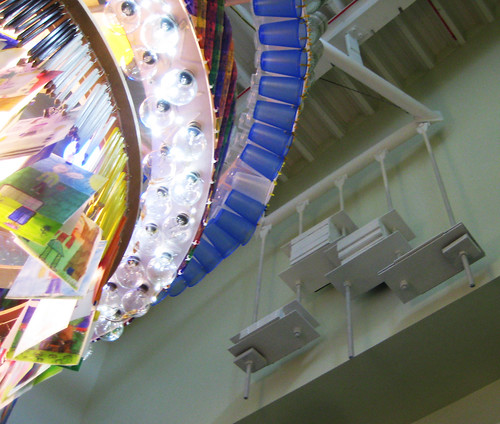
The Eco Chandelier project was officially wrapped up last Tuesday with the official lighting up ceremony at John Paul II Primary School, a joyous occasion for all. Sadly Florence of
we are curious, with whom I was working on this project, was unable to be there, but it was great to welcome back last year's P7 pupils from their new home at high school to see the fruits of their labours.
The launch has already attracted some attention in the press:
TES articleBBC articleIt is being heralded as a great example of a school-wide project that delivers many of the requirements of the 'Curriculum for Excellence', not a term I was at all familiar with until working on this project!
Curriculum for Excellence is basically a Scottish schools initiative to demand a more holistic educational experience for school pupils, in their words, "providing a coherent, more flexible and enriched curriculum from 3 to 18. The curriculum includes the totality of experiences which are planned for children and young people through their education, wherever they are being educated. ... [and] to enable each child or young person to be a successful learner, a confident individual, a responsible citizen and an effective contributor."
These last four qualities are striking to me as they basically sum up the qualities required of a good designer: you have to be willing and able to learn, confident to try new things, responsible about the design you intend to release to the world, and an effective contributor to the design team. It would be easy to apply these qualities to all sorts of jobs but the truth is that the excitement that the Eco Chandelier appears to be generating has more to do with the
way we went about the project than the outcome. And for me this is down to the similarities between the aims for Curriculum for Excellence, and the qualities that are engendered in the execution of a live design project. They are remarkably close. Maybe design projects are the answer.
So how did we go about it? I think the key consideration was to treat every individual as part of the design team, co-design basically. Because the project was live, and we kept reiterating this to the pupils, it was impossible for them to not take an interest, and take some ownership. Although we were there to coordinate the project and keep things on track, the stimulus was coming from the school. Although we framed various tasks and questions into a manageable format for school lessons, we never wavered from the insistence that it was the school who were designing their chandelier. In this way it was relatively easy to communicate the need for considering all stakeholders, choosing materials responsibly, work effectively in groups, all these factors that are essential in solving a design problem, and coincidentally, sought out by the Curriculum for Excellence. It was only really possible by shared responsibility, and trusting in the kids to deliver what was expected of them. And they didn't disappoint. In many cases the pupils (and staff) were surprised at what they could achieve, great for them, but we shouldn't really be surprised by this. This is simply making, doing, on a large scale. It is working as a team to create something of use for the whole community. I'm sure this didn't use to be something unusual!
How is it that our kids are surprised that they can create objects that they are already familiar with in the world, when our world has already been forged by human hands? It's almost as if the hands that made the world are not considered to be of the same type dangling at the ends of our arms. I would suggest that the pupils of John Paul II Primary could do it simply because they were told that they were
going to do it: that those hands are the ones that would shape the chandelier.
Designing is making things that work. There is no better experience for honing one's personal skills than by making something that works. Inherent within the task is the need to consider others, work with others, consider maths, physics, aesthetics, policy, ergonomics, information, communication, money the list goes on. You can't
get any more multi-disciplined than making! The great thing about making is that you can do it as a team, you can share information and experiences, and solicit outside help when needed, and it is super-simple for everyone to understand a)what they are aiming to achieve, and b) when it is done. Why? Because at the end of it you have something like the chandelier!
The Eco Chandelier project has been successful in terms of the Curriculum for Excellence because it was an ambitious making project, and that is all. The fact that this is noteworthy simply highlights our continuing divorce from the act of manufacture, and the need for a re-familiarisation with how things work and are made, simply to know that we can then do the same, better.