Thursday, September 18, 2008

In conversation with the Centre for Advanced Textiles (Part 2)

This post is proud to have been syndicated to the Ponoko blog.


"We want to do things you could never do with mass production," Andy McDonald tells me as we sit in the compact premises of the Centre for Advanced Textiles. From here, just five staff are delivering an on-demand textile printing service, retailing a range of classic designs on fabric, and exploring the boundaries of modern fabrication through several collaborative research projects.


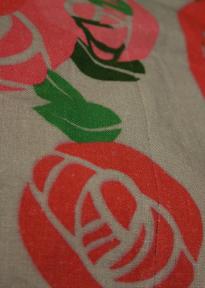
One of the latter that Andy enthuses about is a project involving a "code-generated kimono". For this Andy wrote a script that allows the user to arrange a pattern on a virtual diagram of a kimono, chossing exactly where to place elements of the design. The script then takes these instructions and translates them into patterns for printing on CAT's digital printers, automatically calculating where seamlines should fall and making the patterm continue across them continuously (see bottom image).
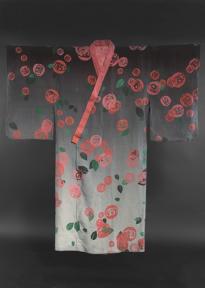
CAT's code-generated kimono


CAT's code-generated kimono- detail of seam


More recently, CAT is working with local design heroes Timorous Beasties, a small enterprise specialising in unique wallcoverings and surfaces for home furnishing. JR cites the Beasties as just the size of business that CAT would like to target and who can benefit the most from digital on-demand processes. The business employs 12 people, screenprinting all their own surfaces by hand in batches, probably the most recognisable design being their very modern Glaswegian take on the 18th century 'toile' style. In their forthcoming collaboration, CAT are exploring new ways for customers to commission designs, using computerised interfaces to give the customer an experience which can then be captured uniquely in the product they take home. It is this factor of 'experience' that CAT see as the crucial value in digital manufacturing.


"Timorous Beasties' strength is in the aesthetic. We can take that digital, building interactions between the customer and, say, the 'toile' scene." In facilitating the customer in creating their own unique pattern, say as a character in their own pastoral scene, JR and Andy hope to create high value products that the customer has an experiencial, traceable link with and therefore will never want to dispose of.
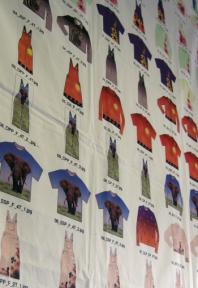

CAT customisation survey


The results of one experiment in customisation hang in CAT's offices


For Andy however, his work isn't about customisation:


"Mass customisation has sidetracked the debate for 10 yrs or so - multi-production builds in flexibility from the core."


Similarly to Ponoko, Andy's vision is of completely decentralised manufacturing, fully exploiting the reduction in design, storage and transport overheads that the digital age allows. He sees the future for CAT as the first of many platforms for small businesses, that would then be able to offer their own web based fabrication experiences to customers. Accordingly, fabrication would become similarly localised and distributed, a system he tentatively calls 'cloud manufacture'.


It's an exciting discussion that brings us round to the rather more traditional example of tartan weavers - local purveyors of technical skills for whose customers negotitation and customisation were easy. And there are few things longer lasting and more globally pervasive than a good kilt!

In conversation with the Centre for Advanced Textiles (Part 1)

This post is proud to have been syndicated to the Ponoko blog.

CAT logoA couple of weeks ago I had the pleasure of a very extensive discussion with the guys at The Centre for Advanced Textiles (CAT) in this very city of Glasgow. CAT is a combined commercial/academic organisation housed within one of the Glasgow School of Art's design school buildings. It currently provides digital textile printing services to small and medium sized enterprises, whilst also quietly plotting a revolution in digital fabrication! I was speaking with researcher and interactions man, Andy McDonald, and surface designer JR.

The centre currently has 2 large inkjet textile printers, as well as the use of the small laser cutter down in the product design workshop. We talked about digital processes for textiles in general, the pair's various projects in using digital processes for customisation, and the state of on-demand manufacturing.


Aurora mixer recently both available and unavailable

This post is proud to have been syndicated to the Ponoko blog.


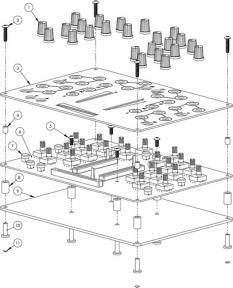
Aurora mixer esploded diagram


I'm a bit slow off the mark with this one - Make reported last week that the Aurora mixer (posted on Ponoko previously here) is now being distributed, and before I knew it the first batch had already been snapped up. The first batch was of 3 fully built mixers though, so its scarcity is unsurprising given the kind of enthusiasm there seems to be for this product. One of the first batch went out to Peter over at http://www.createdigitalmusic.com who wrote this thorough discussion on the item.


On its open architecture Peter writes this:


"... it’s a really remarkable piece of hardware, and one you can get right now and immediately open up and reprogram / repair / rework if you wish. The real test will be to see how people respond to its open-source design, whether that translates into people using it creating some of their own solutions to housing, customization, and software operation in the way they have with some other open projects.


"In other words, Aurora isn’t perfect — but that’s actually kind of terrific, because it’s something more important: open. ..."


"... Bottom line: it can’t be understated that this not only a unique controller, it’s a controller you’d have no problems taking apart physically or in terms of software to change something. And that’s a very exciting thing, indeed."


Looks really positive for this well conceived product. The makers are currently accepting group orders only.

Monday, September 01, 2008

Gift box from Cereal box and other Instructables news

This post is proud to have been syndicated to the Ponoko blog.


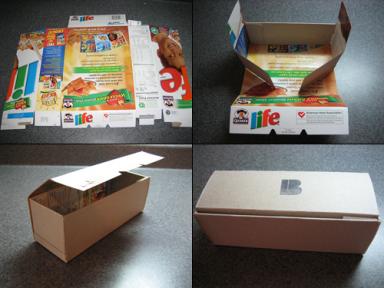
Had to post this rather tasty Gift box from a cereal packet Instructable by Blightdesign, that is Ben Light, a multi-talented (Sculpting, ceramics, web animation, graphic design, painting) web developer from NYC. I particularly like that it uses the entire cereal box, but gives no outward sign of its origins! So you have pretty much a standard used material in a pretty much standard format, just needing folding and gluing to give it a new lease of life. Neat.


Gift box from Cereal box by b.light


Ben also has some lovely bits of wood turning, carpentry and rubber dipping displayed on his site.

If you're really into making Instructables you could do worse than reading this one on How to draw illustrations for instructables. Or it could easily be renamed 'How to draw illustrations for design pitches/design reviews/manuals' in my opinion!


Instructables will soon be releasing their first book, The Best of Instructables Volume I containing over 100 Instructables chosen by a panel and by the Instructables community, out this October.