Saturday, July 26, 2008

The Haptic Gap

This post is proud to have been syndicated to the Ponoko blog.


Today I visited the Haptic exhibition at The Lighthouse, Glasgow's museum for design and architecture. This is a touring exhibition for which Japanese designer Kenya Hara, Chief Executive of the Nippon Design Centre and MUJI, commisioned 21 international architects and designers to "create objects that focus on the sense of touch, instead of colour and form".


The result is a beautifully varied and engaging exhibition, each piece presented lucidly with a short synopsis and material sample so that the audience can appreciate the tactility of the objects. I highly recommend popping along if you're in Scotland.

Haptic logo


A couple of pieces address customisation through tactility: Reiko Sudo's Gazelles table uses textile inspired by animal fur as a tool for users to adapt the table - a collaboration itself with product designer Ricca Tezuchi; each of Keiko Hirano's Paper Wastebaskets is completely unique, being formed by crumpling a paper sachet when wet, a material which dries to form a harder 'can', a strangely resilient feeling paper object. It is worth noting themes of paper, hair, and jelly like materials in this exhibition! Notable exceptions and thus my favourites were Juice Skin by Naoto Fukasawa, packaging that feels like fruit, and Shishiodoshi by Kenya Hara, a kind of ethereal perpetual water installation from defiantly dry paper (there's that stuff again!).


The Hara Design Institute Nippon Design Centre website has a comprehensive collection of images that illustrate what I'm on about!


This all got me thinking about the inherent lack of tactility in digital fabrication, or should I say 'slow' tactility: we can design products entirely on paper and CAD and have no idea how they will feel until the prototype or finished product is made. This is surely greatly inferior to a process where one is designing through touch, with the material in hand from the beginning. That might not be the case when our fabricators are very local, but until then we are seriously impaired by this gap between concept and fruition. I think this is why papercraft holds such interest for me - its immediacy and accessibility with current tools makes it so much more fathomable than, say, 3D printing.


I long for the day when we can have the best of both worlds: a completely haptic and digital system for design and fabrication, whether through enhanced simulation, or preferably through immediate and cheap fabrication.

Friday, July 25, 2008

Machine Collective: Clean, open, modular controllers

This post is proud to have been syndicated to the Ponoko blog.


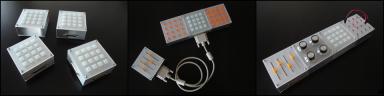
Machine Collective I/O modules


Machine Collective is a group from the Dutch studio XNDR, specialising in custom control surfaces and kits for physical computing. They are developing a range of open source controller modules for artists/musicians/makers. In their words:


"We are working on a range of modules based on frequently used components, sensors and indicators. The prototyping modules are designed to work with development platforms such as Arduino and Wiring. The modules can also be used for other purposes such as circuitbending, DIY synths, analog sequencers or plain old electronics projects."


There's not much to do on the website as yet but the images look pretty exciting, depicting a bunch of boxes that can be connected to each other and the computer via serial ports. The industrial design looks clean and simple, and looks to be similarly open source, consisting currently of just three main components:


  • Acrylic top panel (with/without components)

  • Aluminium base (with/without machined holes and connectors)

  • Acrylic bottom panel (with/without mounting options for pcb's)


One to watch as a handy tool for developers and opportunity for some open industrial design that could propogate hundreds of further projects.

via Synthtopia

Tuesday, July 22, 2008

Pushing Towards the long tail

This post is proud to have been syndicated to the Ponoko blog.


Architectures of Control recently reported on some interesting pieces from the New Designers show in London. Dan Lockton's blog carries some great discussion on design to influence behaviour and as such he often finds some excellent examples of customised design, or design for a very specific need or user.


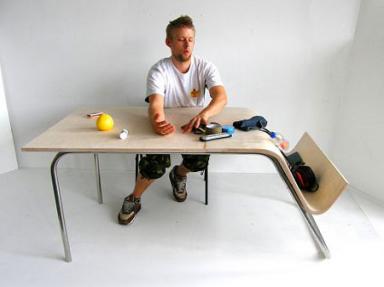
The one that caught my eye as an attractive bit of design, with a peculiar function, was Jennifer Hing's 'Push' Table. Best described by this picture:


Jennifer Hing's Push Table


Not a design suitable for or needed by everyone by any means, depending on your desire to tackle untidyness at a causal level or not! Hing talks about her process in this way:


“I design around people’s natural behaviour, bending objects around the fine details of living.”


Its interesting what results one gets when you bend the object in response to behaviour, as opposed to the usual model of the all-powerful unseen designer, despite his or her best efforts, bending behaviour by designing objects-for-all.


Dan, always the usability expert, puts it like this:


"[the table] intentionally afford users what they’d like to do anyway, at just the right moment:"


I don't doubt that we all want to clear our desks by sweeping things over the edge, but I personally feel the need to bar myself from doing so, preferring to tidy up. This kind of product inherently splits the mass market down the middle, so is much better suited to smaller scale production: I doubt it would make it to the mass market, being just that bit too esoteric - yet for me, products like this could excel in a more distributed, 'long tail' market, where manufacturers can indulge users who desire bespoke products, while still having the economics make sense. And for this to happen, lighter-weight, more direct production processes and open sourcing, such as that demonstrated at Ponoko, are essential.

Monday, July 21, 2008

Netgear Release Open Source Router

This post is proud to have been syndicated to the Ponoko blog.


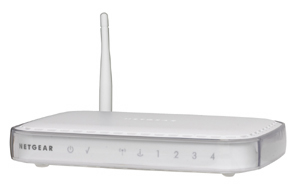
Netgear WGR614L


Looks like a router, smells like a router...


Netgear have released a network router (as opposed to a router for making nice profiles at the edges of your shelves, that would be an even more notable departure), directed at 'Linux developers and open-source experts'. The snappily named WGR614L is supported by the community of user/developers at myopenrouter.com


My Open Router logo


The open source aspects are to do with the firmware, using the Tomato and DD-WRT projects, rather than encouraging hardware customisation, but its interesting to see a product in this market so directly aimed at hackers/makers (similar to Dell's move towards Linux-based systems?).


"The router is targeted at people who want custom firmware on their router without worrying about issues, and enjoy the benefits of having an open source wireless router."


So, the moral is want reliable custom design? - go for open source. So surely if you're having technical issues with the aesthetic styling of your router not matching your custom tastes, you'll want an open source casing too?


via Make

Thursday, July 17, 2008

A Fleeting Few Minutes at Unto This Last

This post is proud to have been syndicated to the Ponoko blog.


I was down visiting the village of London this last weekend, and managed to grab a fleeting trip to Unto This Last, the pioneering on-demand furniture mongers whom we have reported on before.

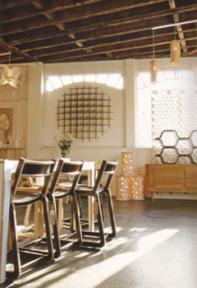
Unto This Last have a beautifully cosy corner premises on Brick Lane, the hub of all things bagel-shaped and trendy in London's east end - although if you're haphazardly navigating there using only your memory like I was, you would do well to note that it is in the quiet, residential bit of Brick Lane north of Bethnal Green Rd that you will find Unto This Last!


Unto This Last shop


image from Unto This Last


So having got there, I only had a brief period to enjoy the shop/factory, but boy did I like it. The shop is packed with their trademark minimalistic products, tables on tables, a bed suspended from the ceiling... As I was told, space is at a premium here, so often items larger items are brought through to the front for storage mid-production to clear space in the back rooms where the action happens. The beauty is the production is entirely visible from the shop - I stood watching for a while captured by that peculiarly mesmerising quality that all computer controlled fabricators seem to have over onlookers! The router head whizzed and whirred back and forth, churning out another set of mysterious shapes from an eight by four bit of ply - clearly for an independent just-in-time business such as this one needs a large, speedy CNC machine.


Unto This Last say that the process that they have developed allows them "to manufacture your order to measure, within a week, at the price of mass-production." And I can believe it, although its a non-stop business for the employees. This was 10am on Sunday and the machine was in full swing, the technician pottering between shop and workshop, finishing off pieces. The prices are more than reasonable, the catalogue's visual language nodding knowingly towards Ikea's manuals, and lovingly entitled "The Data". The other striking thing about this calm, productive environment, was the lack of any dust, noise, or other indicators of light industrial activity - yet all is on display for all to see.


I was most impressed, and excited. And miffed that London should be lucky enough to have the only Unto This Last - as is traditional with each of my visits to the big smoke, I wonder whether the city really deserves or appreciates what its got: a charming, low impact and local improvement on everyone else's Ikea!

Desktop laser cutting from Epilog Zing

This post is proud to have been syndicated to the Ponoko blog.


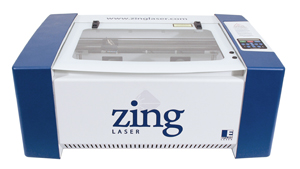
Core77 recently posted on the Zing laser cutter, an $8000 home laser cutting/etching solution that appears to be as plug and play as a printer.

Unfortunately there is preciously little information on the Zing website to explain what the capabilities of the machine are in layman's terms. All I can muster is that it has 25 watts of CO2 laser goodness and has a particularly durable 'all-metal' laser-tube - presumably in response to comparisons with the extortionate price of cartridges for printers.


Epilog Zing laser cutter/engraver


The product appears to be aimed at those who wish to high-quality engrave photos and images onto their iPhones, or perhaps set up a cottage industry to do said engraving, given the initial capital outlay. As we have seen with 3D printers, it's another step towards affordable fabricators for the masses, but with sophisticated consumables such as laser-tubes, is this really a responsible choice given the new waste streams fabricators such as these will create?

via Core77

Nothing but data: from laser to pop video

This post is proud to have been syndicated to the Ponoko blog.


In the same way that the digital fabricator requires the designer to distill their creation down to nought but ones and noughts, so Radiohead's latest video bypassed the visual spectrum entirely in its making. Instead, director James Frost and technical director Aaron Koblin used Lidar (short for Light Detection and Ranging) to capture scenes in 3D, the resulting video becoming purely a post-production interpretation of the data.


The video is for the song House of Cards and can be viewed along with a neat 'making of' here. Here's a snapshot:


Thom Yorke Lidar scan from House of Cards video


In true web 2.0 tradition, the band have made the dataset available as 'point cloud data', that is, a bunch of numbers for every laser sample taken, and as source code for Processing, MIT's popular programming platform for digital artists. If neither of those is your bag, there's a nice wee toy for spinning Thom Yorke's pointillistic face around in you web browser here.

Sure as Radiohead fans are obsessive and brainy, there are already 'user-generated' responses up on Youtube within just 3 days.


One comment stood out to me from the 'making of' video, that was Frost saying of the video that;


"In a weird way it's a direct reflection of where we are in society: everything is data, everything around is data driven in some shape or form and we're so reliant on it now, it seems like our lives are digital..."


As long as one stays optimistic yet rational (as, in my opinion, do Radiohead), this can be an enormously liberating idea, as demonstrated through collaborative ventures such as Ponoko.


via too many blogs to mention.

Friday, July 11, 2008

Aurora mixer looks and sounds lush

This post is proud to have been syndicated to the Ponoko blog.

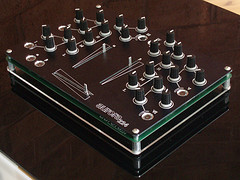
The Aurora mixer is an open source 'usb powered multichannel mixer' project. In other words its a box for manipulating two audio tracks simultaneously through a laptop, similarly to mixing using decks, except there are no big bags of vinyl.


Aurora mixer


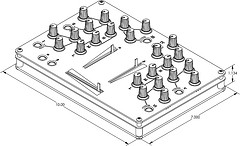
Its another well documented open source project, this time from some MIT/Virginia Tech/Yale boffins: Matt Aldrich, Mike Garbus and Maro Sciacchitano, the latter being responsible for the 'form factor', which I take to mean industrial design. The files for the top panel are available in Front Panel Designer format, apparently something of a standard for enclosure design - surely Ponoko could be used as an alternative for applications such as this, in which case it would be good to see some translation between this format and .eps - this would certainly make the project that little bit more open in my opinion.


Aurora mixer


Vive le difference.


The Aurora website carries a quite impressive video demonstrating its functions - a good example of passionate designers spotting a gap in the market and filling it with their own open design. The designers invite collaboration, with a careful disclaimer:


"... the intent of publishing the files is to generate interest in the community, not to make you rich. we are interested in seeing how you use aurora, feel free to post any mods in the forum."


Images from the auroramixer's Flickrstream