Friday, May 23, 2008

Evil Mad Scientists Post Junk

This post is proud to have been syndicated to the Ponoko Blog.

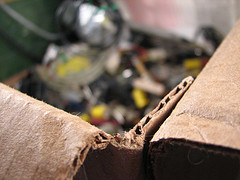
One of my favourite blogs for odd-making-in-a-borderline-electronic-industrial-design-vein is that of the Evil Mad Scientist Laboratories. Most of what Windell and Lenore post is far from junk, but select persons will soon be receiving a box full of the stuff in the mail as part of their new game, snappily entitled 'The Great Internet Migratory Box Of Electronics Junk'.


The Great Internet Migratory Box Of Electronics Junk


Described by Lenore as 'a progressive lending library of electronic components', the idea is to send around a box full of junk that may inspire a new project. The recipients remove as many items as they wish, and replace them with new ones, then add some names to the book in the box before sending the whole thing on to someone else in the book. Its a beautiful idea for collaboration through physical and virtual networks (results will be posted on each of the participants' websites), and a great way to approach a new project or get an angle on an existing one.


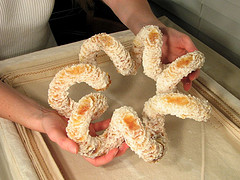
Candyfab results by EMSL


The Evil Mad Scientists are no strangers to innovation and seeing beauty in the details: They are the minds behind Candyfab, the open source 3D printer that uses sugar as a building medium. DIY, cheap(er) and smells like caramel when you're printing!


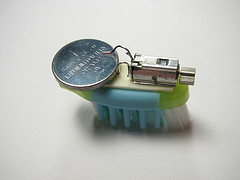
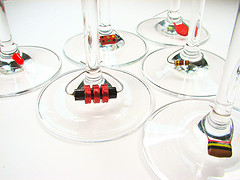
A Bristlebot Component Wine Charms

EMSL are also great at matching bits of hardware with new functions in really creative ways, such as their component wine charms (above) and their really, really simple motor, and their hugely successful Bristlebots, miniature motivators from Toothbrush heads and mobile phone motors (also above). Best of all, the Evil Mad Scientists are all about open source, so all their projects are explained with painstaking lucidity for others to recreate.


All images from Oskay's Flickr photostream

Open Source products on a grand scale

This post is proud to have been syndicated to the Ponoko Blog.

So you thought you’d seen every open design project on the web? No? Well, I did, and then I came across the Mini-650 racing yacht project.Hans Zwakenberg, of mini-650 says:


“Designing a Mini-650 racing yacht as a group effort, using the Internet as the enabling technology to bind a group of interested individuals together, is what this site is all about. As far as I know, this project is one of the very first to try and apply this development concept to the fascinating world of racing yacht design.”


Not being a naval architect, I don’t understand a lot of the downloads, but I’ll take Hans’ word for it! Then again maybe no one else could decipher them either as the project doesn’t appear to have been that active of late. Its there to be picked up.


Other notably ambitious open design projects include two cars (OScar, with a great website, and the Open Source Green Vehicle, with a perplexing one), a house and a surf kite project (Zeroprestige kite, which alas is no more, as the protagonists went onto even greater things, like starting Instructables.com).


OScar


OScar Concept by Tiago Do Vale


OS House


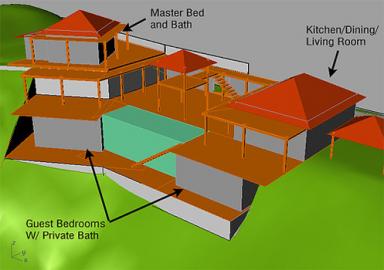
Open Source House concept by Rahm Rechtschaffen


Its one thing sharing designs for lamps and furniture, but how can it be feasible on projects such as cars and boats? A similar problem faces the open source software community when they build an operating system. And similarly, the way to do it seems to be in breaking the project up into manageable chunks, not rushing, and lots and lots of discussion! But with the grandest projects come the grandest and most inspirational statements, such as this from the OScar manifesto:


" [To] build a car without engineering center, without a boss, without money, and without

borders… but with the creative help of the internet community – that is the meaning of

empowerment, the meaning of challenge, and the initial reason for the internet."


These projects are all currently at an early stage and perhaps at the best stage to get involved, although given their wide scope, also likely to branch off into new projects in the future.

Mechanisms, Automata and Ponoko

This post is proud to have been syndicated to the Ponoko Blog.

For those of you new to automata, these are mechanical toys or sculptures that, when cranked or motorised, re-enact movements through a system of mechanical processes, such as cranks, cams and gears. The results are often beautifully presented and can be quite beguiling, such as this one from Philip Lowndes, Quiet Contemplation of a Sandwich (check out the videos here).


Philip Lowndes' automata


Some makers are already using Ponoko to create working mechanisms, and the laser cutting process seems quite appropriate for making most of the elements of automata, which have to be precisely crafted, often from wooden board. What’s more, there are a host of resources for the budding automata builder on the web.


The Make blog led me the Cabaret Mechanical Theatre’s modular automata kit – a collection of wooden pieces that can easily be put together to form your own automata, while learning about the mechanical principles most commonly used in the devices. The Cabaret Mechanical Theatre once had premises in London’s Covent Garden, which are sadly no more, but the group continues an online presence, selling kits, books and exhibiting online the work of automata makers such as Paul Spooner, Carlos Zapata and Tim Hunkin, whom I have previously blogged about.


The first stop for automata info must be the Automata and Automaton Blog, Dug North's very well updated chronicle of automata on the web. He offers some great resources for those of you interested in new mechanisms and often link to the Sands Museum, an online museum of industrially produced mechanisms, catalogued in some detail. Check out Philip Lowndes' Anatomy of an Automaton for some insight into his craft.

There’s a good line in plans for automata from cardboard too, including these at the Cabaret Mechanical Theatre shop and these at Flying pig.


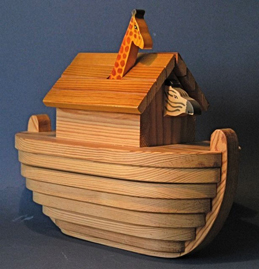
Philp Lowndes' Noah's Ark puzzle

Incidentally, a puzzle just calling out to be laser cut is Lowndes' Noah's Ark, the plans for which can be bought here.

Beware: automata can be addictive!


Images by Philip Lowndes

Sunday, May 18, 2008

Cardboard Design a-go-go

This post is proud to have been syndicated to the Ponoko Blog.

Further to John's recent post about Ruit Keenan's cardboard furniture, I got thinking a bit more on the subject of this ubiquitous material. Long time favourite of bodgers and school craft departments, it has a perhaps unfair reputation for shoddiness. But it is its very transient nature, this tendency to degrade, that makes it such an alluring candidate material for the sustainability-minded furniture designer. And why it is one of the prime materials for packaging, being discarded in vast quantities when product has reached recipient (I can't begin to effectively communicate the festering relationship I have with moulding Ikea box carcasses in my backyard). Hence, if it can be caught at that moment and upcycled into even a very temporary piece of furniture, it's surely a good thing. But there are plenty of examples of cardboard furniture designed to last a long time indeed.


The other great thing about cardboard is that it is warm, its textural, easily printed on, and one of few materials that everyone interacts with on a daily basis: We've all played with and explored it, even if it was as a two year old and it was that box that the train set came in!


Treehugger recently reported on a project carried out by students of the University of Idaho, and rounded it up. with links to many other of their articles on cardboard items. Some great manipulation of the material there.


Foldshool Stool


Of course, the 2D nature of cardboard also makes it ideal for open source design, as the data for a net can very easily be shared, understood and transferred to the object. Foldschool is a project that does just this for kids' furniture. To quote from their press release:


Each fragment of the pattern can be printed

out on DIN A4/US letter or on DIN A3/Tabloid.

Therefore the pattern charts can be manufactured

everywhere. The assembly of the furniture requires only

easily available tools and devices: cutter, ruler, folding tool,

cutting mat, spray adhesive, needle, glue and masking tape.


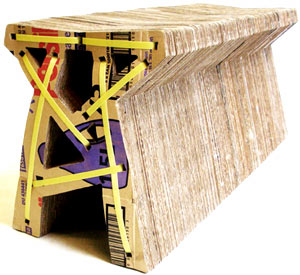
Raw Bench


Another great piece is Jason Iftakhar's cardboard bench from a couple of years back. Jason's bench was designed to be produced from the bailing machines already used in supermarkets to discard cardboard. Its a really well executed bit of design for manufacture!


If you liked this, check out the Treehugger article as there is much, much more in the world of cardboard items.

Saturday, May 17, 2008

Why open design is a ruthless ideal

This post is proud to have been syndicated to the Ponoko Blog.


So how can a designer make money in the open source model? If we're giving away our IP for free, what else can we charge for? Firstly, there's no tenet that says one must give away ones designs for no money for it to be free. We're talking 'free' as in 'freedom' here so we can still charge customers to buy our design source - the freedom comes in what license you give to the customer once they have the source. Traditionally, buying a product grants you no freedoms over developing it - you're not blocked from hacking a piece of furniture, say, but you're not facilitated either (in fact many gadgets do bar the user from opening them, sometimes for good reason) - and you'd certainly be in trouble if you tried to manufacture and market your own derived version. So in selling open design source documents you grant the customer the right to make derivative works, and, optionally, to market those works. More about that later.

In the case that a designer gives away their source documents for free, the onus to make money is put squarely on the manufacturing and marketing stages of product development. This makes great sense as a driver of good design as good design is essentially about optimisation for both production and for the user experience (if this is great, the product can almost market itself). And if the design source is free, more developers are likely to contribute, making for a bigger crowd designing the product, which may or may not be a good thing. So for this crowd of designers giving away their IP for free to get any remuneration, they have to be on the payroll of the company making and selling the product, ie. in-house designers. Why would any company pay designers who will happily give away their work for free? The only reason must be that it is the only way to ensure great design, and to ensure that the next great design comes from one of their designers. This is clearly a rather idyllic situation in one sense: being paid to simply design as we please. In another it is hellish, as the criteria for the designer to get paid is not a case of simply putting the hours in, but of being on top of the game, and doing good design constantly. Its a Free as in Beer model and as such, only works if you can hook manufacturers on the quality of your future work. Those who can do this would be in a prime position in the job market. Those who can't are left to design simply for fun. If they can afford to have fun.

Design wins, good designers win, users win, bad designers lose.

As a freelance designer then surely it makes more sense to sell your design source for a fee, as otherwise there is no way to ensure any income. Any company could grab your design source and sell thousands of units with no obligation to give you a penny. Whichever way you look at it, it seems that it does not pay well to be a freelancer in the open design world. Unless you are also manufacturing.

It is when we consider the manufacturing that the position of freelance maker makes a whole lot of sense: In any form, open design will always encourage a competitive market between manufacturers: When we can all make and sell the same product, the competitive edge must come from how well we do it: this means sustainability, economy, locality, appropriateness, inclusivity, accessibility, customer relations. All the criteria by which a manufacturer is judged by we users. When the manufacturer cannot claim a monopoly on manufacturing a product, they have to compete on the stuff that really matters to the customer.

Society wins, good manufacturers win, customers win, bad manufacturers lose.

I have assumed in the last few paragraphs that all design source is distributed under a license that permits commercial use. Of course this does not have to be the case. In fact we do not have to look far for examples of open design which denies commercialisation by anyone other than the originator: Its called co-design, mass customisation, user-led design, beta testing. Its what all the manufacturers are doing now: opening up to a user/developer community while retaining their exclusive claim over a product. Its not really 'free' as in 'freedom' and its only tenable until the day that the fabrication technology needed to convert design source into a personal product is in our homes.

Image by TheAlieness GiselaGiardino

Tuesday, May 13, 2008

Phil Torrone's favourites from Maker Faire

This post is proud to have been syndicated to the Ponoko Blog.

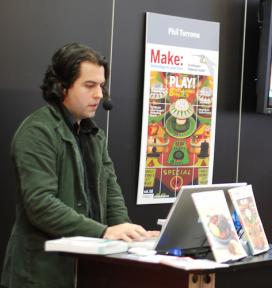
Boingboingtv has a good video up in which Phil Torrone, editor of Make magazine, shows us some of his favourite projects from Maker Faire 2008 last weekend. These include soft toy electronics, 'fablabs' and the "brain machine". Phil comments a little on the links between the maker movement, the affordablilty of digital fabrication, and the future of product personalisation.

Its good to get a little insight into the goings on at Maker Faire when I'm stuck over on this side of the atlantic - there's such a vibrant network of makers out there, hopefully one day I'll be able to attend a Maker faire myself!

Phil Torrone
Update:

There's also an interesting perspective from the businessmen at Forbes.com here. Some chat with Make magazine, Bleep Labs and Mitch Altman on the reasoning behind DIY product success stories. The emphasis on the need for building a product community and sharing (and thus flexible licensing I surmise) is interesting.

The mysterious appeal of the competition

This post is proud to have been syndicated to the Ponoko Blog.

It’s interesting how the indie design community respond so well to competitions: Clearly, we need briefs to flourish, we need constraints. The response to last month's Ponoko competition is a case in point. So it’s no surprise that brands keep hurling them at us.
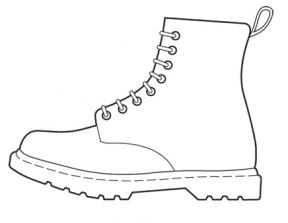
Doc Marten’s is one of the latest with their Freedm campaign, a website that allows you to decorate your own Doc Marten’s boot with the chance of having your design made up for sale (via Core77). This is one of many similarly enticing yet constrictive competitions in which getting your entry manufactured is still ultimately down to chance. At least customisation frameworks such as those offered by Nike, Etnies, and Timbuk2 guarantee some return on your investment of design time and effort, and some offer more freedom.
A Doctor Marten

The cynical side of me sees these competitions as, at worst, simply an attempt by brands to get a lot of ideas for virtually no effort or cost. At best, they might be a means of gaining publicity by jumping on the DIY/open design bandwagon. But maybe they’re genuinely part of the movement and a necessary framework for indie designers to work within. However, if this is the case, it would still be nice to have more opportunity to recover some expenses than relying on the chance that one is going to win. How can we stop ourselves being exploited like this?

I suspect the answer is that these competitions and services are really aimed at facilitating design by the 'non-designers' discussed by Dave here. For more experienced designers, brand-led competitions such as the Muji design award, attract a great deal of interest, presumably because the briefs are so much wider open. Still, surely our time would be better spent directed towards projects that have more grassroots social impact, or that we at least have the means of building or marketing ourselves, such as those found on Thinkcycle? Sadly, this repository (and others) of collaborative, appropriate design, that offers the same reward of having one’s designs become reality, has been significantly less subscribed to.

It seems we relish constraints, while demanding a certain minimum of freedom, and the balance between these determines to what extent we are designers or 'non-designers'. However, whichever we are, it seems that we are ultimately mostly interested in prestige.

Lee Krasnow: Small puzzles, big conundra from a big saw

This post is proud to have been syndicated to the Ponoko Blog.

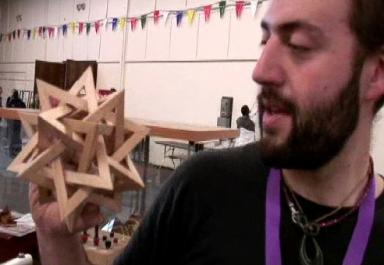
Since we’re talking about puzzles and games, I thought it was worth pointing out Lee Krasnow. Lee is a puzzle-maker from San Francisco, and creates some awesomely perplexing objects! There is a great interview with him over at makezine, in which he talks the viewer through some of his puzzles and introduces us to his method of working.
Lee Krasnow

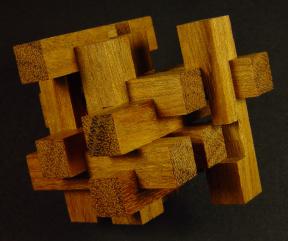
Lee Krasnow 2-in-1 Puzzle


Lee Krasnow (above, makezine) and one of his puzzles, 2-in-1 (below, pwdbp.com)


Perhaps the most incredible thing is that Lee's tool of choice is a table-saw. Using a jig of his own design, he manages to cut highly precise and tiny parts – he has posted an instructable describing how to make some jigs and ten of his puzzles here. It’s daunting, but highly inspiring stuff and makes me think that there’s no reason why a laser-cut puzzle should be just a 2D affair.

In fact my favourite Ponoko project of late has been Carbon by ckharnett (a recent product of the week) – a game-like geometric construction of simply hexagons, pentagons and triangular connectors. The constructions possible with this system are endless!
Carbon

Riding the open hardware wave with ladyada

This post is proud to have been syndicated to the Ponoko Blog.

If you haven’t already, check out ladyada’s website. She’s something of a veteran of open sourcing hardware, having developed several (mainly electronic) projects while at MIT and, indeed, since.

My favourite is the Spoke POV, a persistence of vision toy for your bicycle wheel. I have made up a couple and found her various source documents incredibly well written and helpful (she provides detailed assembly instructions, links to places to source components, schematics of the circuitry, circuit board layouts, source code for software elements. And of course you can download the latest version of the firmware and software and she’ll sell you a hardware kit at her commercial arm, Adafruit Industries (having limited interest in building electronic hardware, but an inexplicable urge to solder, this is what I did). The great thing is, there is a burgeoning community of developers and users on her forums – you can even just chip in with product suggestions if you don’t want to get into detail. And it’s not just for the SpokePOV- there are many more products to help develop.


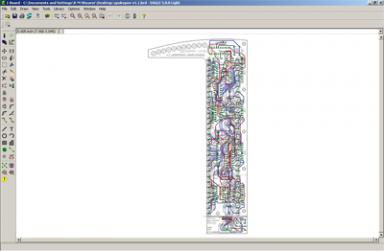
SpokePOV board in EagleCAD


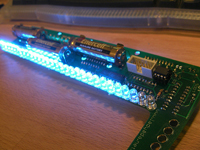
SpokePOV board being assembledSpokePOV in use


One development I would love to see, and which I fully intend to get on to with time, is a housing for the SpokePOV – the current trend is for cable tying the circuit board straight onto your spokes. I have in my minds eye a vacuum formed casing, and posting the source for the mould as some kind of 3D CAD file. But maybe I should be thinking of something laser cut, and using Ponoko as the platform.

It’s really exciting to think of what’s possible, developing a product for an already successful opens source software/hardware project. And it would be fun to take on the challenge of doing it with laser cutting, given that a standard platform now exists in Ponoko – that is, until Ponoko starts offering moulding!

The truth is, I haven’t got onto it in about a year, so may never. But have a look at ladyada’s projects and maybe see if there’s anything there that piques your interest!

Incidentally, ladyada also has a very interesting section on Open Hardware, covering her definition, licenses, and a list of projects from across the web.

Images courtesy of Bekathwia and Ladyada

Tim Hunkin and the Issue of the Inventor’s Identity

This post is proud to have been syndicated to the Ponoko Blog.

A while back, the Core 77 blog led me to an archive of the 80’s series The Secret Life of… which beautifully relates the history and design of various household items.

But the real star of the show is the presenter himself, Tim Hunkin. He is one of a few multi-disciplined tinkerers whom I count as a personal hero. Cartoonist, inventor, broadcaster, sculptor – his book Almost Everything There Is to Know was a formative influence in my childhood. He is a great example to any of us who want engage in this new world of designing, adapting and making, embodying as he does both passion for the end product, as well as a broad variety of skills and experience to get there. The great thing is with the enablement of the web, we can all be part time designers, or adapters, or makers, and indulge our multifaceted natures while still holding down a day job. If not making it a day job.

Tim Hunkin


Incidentally, I constantly have trouble defining what it is I do in my studio/workshop – increasingly I err towards the term ‘tinker’ which is unsatisfactory, evoking activities of a more mischievous nature than they often are. On his personal site, Hunkin goes for ‘engineer/cartoonist’, which gives no indication of his myriad other talents.

We need a term for this new breed of inventors to which I belong and which sites such as Make, Ponoko and Instructables seem to attract. We are changeably referred to as makers, industrial designers, inventors, indie designers, hackers: none of which seem to embody the activity truthfully (the term ‘maker’ really doesn’t cut it as a valid activity amongst some of my peers, who have the benefit of such well established terms as ‘doctor’ or ‘telesales operator’). My favourite has to be ‘post-industrial designers’, as referred to in this discussion on Core77. It would certainly be good to stick to one job-title in the future, and this seems to infer the right amounts of professionalism, independence and irreverance for me!

Anyway, back to Hunkin. Have a look at his site and you will find an Aladdin’s cave of truly joyous objects, thorough explanations of his workshop and methods, all infused with the man’s quiet, considered adoration for mechanical creativity. An inspiration, whatever he is and whatever we are!

The image above is a self portrait by Hunkin, and the images below, a human sewing machine from The Secret Life of the Sewing Machine and a cartoon from Almost Everything There is to Know, used with permission from Tim Hunkin.

Human sewing machine by Hunkin Hunkin on Music

Optimising Materials Use with Ponoko

This post is proud to have been syndicated to the Ponoko Blog.

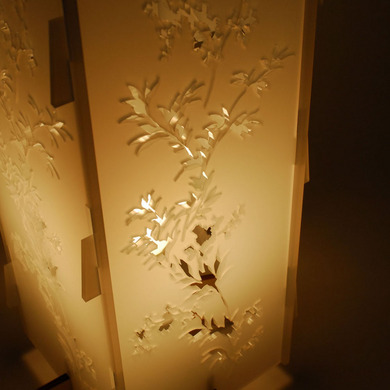
In order to get free delivery back in January, I rather hurriedly had a variation on Dan's box lamp cut, and was kicking myself when the pieces arrived for not making full use of the hardboard - I'd overlooked the fact that the box lamp only uses one bit of the hardboard, and should have added something useful as Kyokpaesshowroom (bit of a mouthful I know) did: a wee tangram puzzle. Neat.

It would be great if Ponoko alerted the designer when they are about to waste material. But since we already have a ready-made repository of laser cutting template files in Ponoko, could a program be developed that analyses your .eps file and suggests other designs that could be added to make better use of the material? This could even be done in such a way as to add a little chaos to the process, leading to some interesting mashups of designs in unintended materials, or at unforeseen scales. It seems that Ponoko has provided a great opportunity for improved efficiency of materials in this way. A quick search brings up the imaginatively named Sheet Layout but this seems overly powerful for most people's needs, and I'm unclear as to whether it could automatically place a cutting path in a given space.
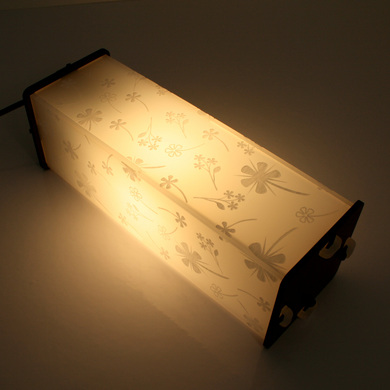
Incidentally, the case of Dan's box lamp seems to be a good example of ‘remixing’ design data on Ponoko: starting with his floral design;

Dan's box lamp

followed by Kyokpaesshowroom's dragonfly interpretation;

Kyokpaesshowroom's box lamp

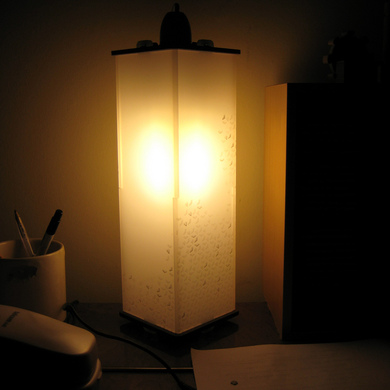
and then my tea-leaf inspired design (a pattern that I pretty much cut and pasted from another of my projects):

My box lamp

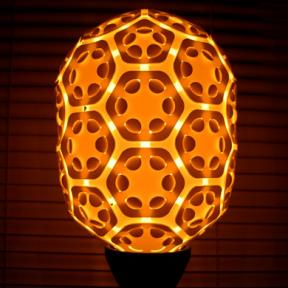
As derivatives of a ShareAlike license, all of them are available for free, on attribution and non-commercial terms. Plus there are more lamp designs using similar principles. VodkaandOrange's Bonsai lamp, below, makes great use of the laser cutter to create an intricate cut-out pattern in the acrylic. Isn't light brilliant?

Vodkaorange's Bonsai lamp

Ponoko Syndication

As I mentioned earlier, I am now writing posts for the Ponoko blog. But I seem to have laxed in my own blog! So I'm going to paste in the ones I've written thus far for Ponoko, and then start blogging for here first, hopefully, and syndicating the relevant and more lengthy posts to Ponoko.

Sunday, May 11, 2008

Microtrends: Bristlebots - Times Online

Microtrends: Bristlebots - Times Online

Article about Evil Mad Scientists' Bristlebots and variations on.

Forbes on DIY success

Forbes.com Video Network

Warning: may contain business speak and questionable ethical standards. But an interesting take on the DIY movement.